

Summary:
- AI Agent technology has sufficiently advanced that manufacturers can now use them to build value-creating operational apps today.
- This does not mean that all firms will incorporate AI well. In fact, the non-deterministic nature of AI means it will only magnify the dysfunction of firms that do not have a well-defined AI data strategy.
- The difference between the firms that will thrive and the firms that will crash is how they incorporate context into their AI strategy.
- The key to context is a foundational model that fully represents the manufacturing domain.
- The outcomes include faster onboarding, quicker screen development, reduction of error-prone manual work, reusability of AI tasks across problems, sharper insights, and faster fixes of data and application logic.
Moving from potential to Production
AI is undoubtedly useful for many business problems. The rise of agents and harnesses has proven especially fruitful for saving labor and generating code. Now discussions of AI strategy are no longer about potential but about implementation.
However, successful application of AI in manufacturing requires a particularly principled approach. While a SaaS startup may be able to build a user application with just “vibes,” manufacturing is a domain where the phrase “move fast and break things” could literally refer to physical things moving at dangerous speeds and breaking expensive equipment. But that doesn’t mean that manufacturing can’t benefit from AI―in fact, enormous benefits are already there for the taking.
In other words, innovation in manufacturing can be realized now. Firms just need to move towards the production possibilities frontier that already exists.
In all likelihood, manufacturing is going to derive enormous efficiencies from adopting AI. However, not all firms will do it right, and faulty approaches will also result in costly disasters. The difference between success and failure is the strategy that firms adopt with their data: the better the data quality and context, the more potential a firm realizes for deep applications of AI.
And the foundation for achieving high quality and context is in the choice of using the proper manufacturing data model.
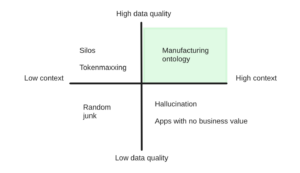
Context is key
Organizations that fail to adopt comprehensive context structures — supported by a robust data layer — will perpetuate data inefficiencies and face heightened financial costs, as well as legal and reputational damage.” – Gartner
At Rhize, our emphasis on context is nothing new. In fact, we’ve been desiging for context since our early days in 2018. However, the explosion of LLM architecture has made context the key to unlocking new possibilities of production.
The reason context matters to AI decision-making boils down to two things: focus and memory. Anyone who has built code with AI―or even discussed a technical topic in a chat with an LLM―knows that focus and accuracy can quickly go off the rails. This is because LLMs have no problem generating infinite amounts of code or text. Furthermore, the actual input to the Agent must be constrained to some amount of tokens, since context “rots” as it gets larger, causing increasingly poor quality output. Restricting LLMs to precise context is one of the most profitable ways to ensure accuracy.
And accuracy matters much more in manufacturing than it does in many other industries. Inaccuracies in manufacturing systems compound. Improperly defined processes lead to poor scheduling, inventory control, and sloppy execution. Poor scheduling leads to over- or under-utilization. Poor execution leads to waste and poorly tracked performance. Poor data provides no insight on how to improve.
For firms to realize the massive potential of AI, the key differentiator is the model that it uses to represent the manufacturing domain. The best approach is ontological, with a full vocabulary to represent every element of the manufacturing operation and their relationships. The ontological model represents the operation in semantics that are understandable for both humans and machines. Every event and resource becomes an instance in the knowledge graph, so context deepens with use, driving ever better efficiencies.
The importance of the model
A data model is a representation of a business domain. All manufacturers use a data model, whether they try to or not. However, while an ad-hoc data model is going to be vulnerable to changes, data quality issues, and insufficient representation, a well-defined data model is flexible and comprehensive enough to represent all entities, events, and interrelationships in the manufacturing operation. It is very hard to come up with a thorough manufacturing ontology from scratch, but, fortunately, ISA-95 already exists as a perfect foundation for an ontology.
Though they precede generative AI by decades, it turns out that ontologies are the ideal input for agentic use cases. There are two main reasons why: data quality and data context. By providing a template for all necessary entities and relationships, the data model creates guardrails for what kind of data gets stored. When this data is fed to AI, the contextual relationships help build applications and answer questions with fewer logical errors.
Quality
No frontier model can escape the problem of garbage in, garbage out. The first step to avoiding garbage is to build a system that stops it before it comes in. Here’s how the ontology model provides the framework to do just that.
- The schema defines valid and invalid relationships and behaviors. When first defining an implementation, just the act of mapping the use case to a model enforces a basic level of representational correctness.
- Once live data is ingested, schema enforcement ensures that it is well-formed. While various deterministic checks and statistical controls are required to control data inputs, the ontological layer provides the first guarantee: this data actually represents the domain it’s supposed to.
- The data model provides efficient representation and aggregation of similar entities. Ad-hoc schemas result in frequent version changes and ambiguity about what data represents. Over time, these differences and changes result in brittle application design, data silos, and inconsistencies.Starting with the correct data model avoids this fragility. For example, it’s not uncommon to find that the same firm uses different data models for the same entities across sites or systems. The ontological hub harmonizes this data into a standard model. For example, all material, no matter how different, will always be represented by material lots, definitions, and classes. This is also true for other resources, processes, and events.
- Since models are reusable and interconnected, each incremental use case enriches the existing data by providing more context. This precision promotes application modularity and query precision.
For detailed examples of how data relationships work in practice, read our blog Want High-Quality Data? ISA-95 is Your Path and Model. We should also mention that a schema is just one part of how the manufacturing data hub’s architecture promotes quality: there are also technical considerations about reliability and durability. For technical details, read How Rhize Works.
Context
With a proper data foundation, the next key to designing agentic systems for manufacturing is context management. Here the ontological model is again best.
- Once data is ingested, it exists in a graph of relationships. The graph provides the minimal context necessary to manage tokens. For any business use case, whether operational or analytical, simply turning agents loose on the full model wastes tokens. Even as models progress, LLMs have finite memories and context windows that rot.
- The data model provides guardrails for autonomous application development. A high degree of context means that the agent can better infer what needs to be done, and the schema enforcement prevents the agent from making inefficient, duplicative data structures.
- Having a model that encompasses all necessary data provides a way to provide incremental access to a subset of components necessary for its use case. If that subset proves inadequate, it can efficiently add context edge-by-edge.
- The ontological schema is in a sense self-documenting. The model provides a vocabulary to describe every entity in the manufacturing organization, whether it be a static entity such as a model of a material definition, a dynamic entity such as a just-in-time schedule, or a stream of events, like sensor data from a message broker. The names of the schema are broadly intelligible to both humans and agents, and, in any case, all relationships and names are documented in the standard itself (or in Rhize’s case, directly in the schema). This reduces the burden of making an independent semantic layer for operational and analytical data.
Outcomes
To summarize the last section, the ontological foundation provides data quality and context, the keys to successful agentic applications.
With the right foundation, manufacturers can use agents to drive far-reaching changes in their digital strategies. That leads us to some examples of how.
- Faster onboarding. New operators can use the knowledge graph to query high-level information about the plant―things like what processes involve this machine, what material goes into this product, and so on.Furthermore, the ontology eliminates the need for direct access and skills about source systems. The chat interface replaces the need to learn how to use specialized interfaces or rely on technical experts.
- Reliable outputs. When using a chat interface, the knowledge graph its achors its to the scope of what it can query from the data, minimizing the risk of hallucination. When querying data or generating code, agents can have instructions and harnesses to validate data against stored schemas and tests.
- Quicker application development. Build custom frontends using the standardized backend as a guardrail. Quick iterations and operator feedback mean that the data hub soon becomes a source to drive new innovation in production, quality, inventory, and maintenance.
- Better insights for reports. Just as you can chat with the plant to onboard, you can also chat with the job response data to get summaries and insights.
- Reduction of error-prone human tasks. A wide range of operator tasks are very tedious and boring, but not quite so repeatable that they can be automated away with a deterministic program. Agents in the loop are ideal for these types of tasks, which require some discretion, but not actual human judgement. Here’s an example from Rhize, Downtime Reason Codes.
- Reusability of AI tasks across domains. Every use case that adds instances to the model incrementally extends the foundation for subsequent tasks. In large, multi-site manufacturing operations, the ability to port a workflow from one site to another can save much time. Using a data model and set of standardized instructions, once you have one agentic task nailed down, you can quickly port it to similar ones.
- Insights. Don’t forget―there are many non-LLM use cases of AI, too. The knowledge graph also adapts perfectly well to “classic” machine learning tasks. The rich set of attributes and relationships lends itself perfectly to both supervised and unsupervised classes of learning to predict, classify, and optimize your operations. Of course, scaffolding machine learning experiments is much easier when an agent can help (often coding is not a data scientist’s strength―analysis is).
For more detail and examples, read our next post details how Rhize and our customers are using agents in production today.
It runs on a data hub
Whether you like it or not, agents are coming to the shop floor. Some experiments are going to work, some won’t, and a few will drive lasting value. We bet the big winners are going to run on top of a data hub.