

SAP has announced an end-of-life schedule for its core manufacturing applications, SAP ME and SAP MII. Known for their power and flexibility, these applications have long existed deep in the technical stack of complex, multi-site manufacturing operations. The total value of production that has happened on these applications is easily billions, if not trillions, of dollars.
This end-of-life event constitutes a critical moment for manufacturers to consider their transition plan. Unfortunately, no turnkey substitute exists. SAP’s official replacement, Digital Manufacturing, is an opinionated, cloud-only solution, one that leaves the bespoke applications built by customers on MII and ME over the past decade stranded.
Currently, migration estimates range from 12 months for simple operations to 36 months for complex, multi-site installations. In other words, if you’re reading this in 2026, the clock is already ticking.
Given the complexity of migration and the frankly inferior set of new SAP offerings, manufacturers should use this time to consider if they’d be better served elsewhere. Rhize, we humbly submit, is the best alternative around.
The power of a headless approach
While SAP is a name that always carries heft (at least in invoices), ME and MII were genuinely powerful products. MII connected the plant systems and ME provided the MES functions. But more importantly, with their programmable core logic engines, businesses could use the ME/MII stack as a backend to build outstanding applications customized for their needs. And indeed, outstanding applications for manufacturing execution have been built from this combination.
This architectural approach of separating backend logic from frontend presentation is what we call headless. In manufacturing terms, the “head” here refers to the frontend screens and the “body” is the backend connectors, processors, and database that execute data flows and process transactions. While SAP never used the term, its ME/MII combination approximated a headless architecture.
For companies who have built awesome custom logic and apps that sit deep in their existing processes, only a headless path, such as Rhize, can provide a means of porting their existing screens intact. And SAP’s official “replacement,” DM, is decidedly not headless.
Rather, DM follows SAP’s new “clean core” model, an approach that has the explicit intention of minimizing customization. As an example of a major departure from the openness of ME and MII, DM offers no direct access to the transactional DB. If you want to read about the limits of customization from an author with experience on both sides, we recommend reading The IIOT Blog’s article Is SAP DM a Replacement for MII?
People will find workarounds, but fundamentally, intense customization in data-intensive environments will always be a challenge with SAP DM.
The fragmented path towards “upgrading”
Besides its lack of programming flexibility, another critical flaw of SAP DM as a replacement is that it’s really not a replacement at all. Rather, DM is one component in the suite of new applications required for implementation parity. For details about the complexity of upgrading, we again recommend The IIOT Blog. SAP MII END of Life: What next lays the upgrade path out in detail.
In short, the transition is not simply moving from SAP ME/MII to SAP DM. It’s moving from SAP ME/MII to ProdCon, CloudConnector, DM, Event Mesh, and DataSphere. Complexity and fragmentation come with real cognitive costs, which turn into slowness, confusion, and friction, all of which increase both cognitive demands and the cost of goods sold.
Cloud-only: a limitation
SAP’s Digital Manufacturing is a cloud-first solution. In mission-critical areas, like industrial shopfloors, high latency or low availability can cause severe financial and physical harm. For unavoidable reasons of physical distance, shifting MES compute to a cloud provider necessarily increases latency. Furthermore, outsourcing to a third-party cloud necessarily leaves the manufacturer powerless to fix outages. Finally, the global TCP health rate is still only 80%, so plants in WAN-constrained geographies are more exposed to connection risks. To mitigate these problems, SAP DM offers an Edge component, which runs locally and has a backup of the cloud data on its cache.
In highly regulated environments, such as pharmaceuticals, manufacturers must maintain complete control of its system versions and their dependencies. Version changes require audits and expensive retests. Even with an “edge” node, the rolling upgrades and general lack of transparency of third-party cloud services make DM a risky, if not impossible, solution.
Fine, you might think, perhaps pharma a no go, but many of SAP ME’s heaviest users work in discrete. While these users don’t need to worry about CFR compliance, they do need an operations system that is flexible, powerful, and minimizes complexity. And, as we mentioned in the last sections, DM adoption produces the inverse effect: removing flexibility and boosting complexity.
Rhize: flexible, headless MOM for the modern world
Rhize is the actual natural successor to SAP ME/MII. It was built by experienced practitioners; it’s battle tested in various industries; and it provides a flexible, headless unified stack for any operations use case.
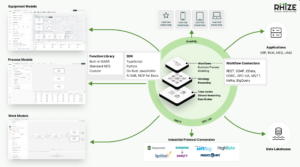
To summarize some key features:
- Headless by design. Rhize was built out of frustration with existing MES vendors that forced use cases into their one-size-fits-all design. From day one, Rhize has been built with the intention of providing a powerful data model and rules engine on which you can build any application you need. With the explosion of GenAI, prototyping screens is easier than ever, as long as the model guarantees data quality.
Compared to SAP DM, Rhize presents far more flexibility, with an architecture designed to be the backend for any frontend you want to make. - Built-in, powerful ontology for any use case. Rhize’s manufacturing database comes with an interconnected model based on ISA-95. Applying this ensures your data has a high degree of context and accuracy, the necessary steps for data governance across large projects.
Rhize’s flexible data model readily adapts to any use case in the defining, planning, execution, and analysis phases of an operation (that is, all phases). The SAP DM model, on the other hand, provides a one-size-fits-all solution for a specific set of use cases―not necessarily your use case, not necessarily your solution. - Infinitely scalable. The flexibility of the ISA-95 core means that Rhize’s power scales and gets richer with every new use case. Whether extending a plant-level system for a new use case or transporting an existing solution to a new site, each new use case requires less work and transmits more contextual data. We call this enrichment process Use Case Stacking.
Rhize is also infinitely scalable in the computer architecture sense of the word. It runs on-premises in modern containerized, high-availability deployment. It has event brokers to decouple messages passing across data streams of all the modern protocols. Compared to the black box of SAP DM, Rhize is open, robust, and flexible.
Major companies in both batch and discrete have already used Rhize in major multi-site implementations. Now that ME/MII are being sunsetted, Rhize presents the true step forward. Get in touch.