

This article describes how a Manufacturing Data Hub can help operational manufacturing teams break down silos, rapidly develop new solutions, and stack use cases in a way that compounds value.
In this context, “Operations” refers to everything that happens to coordinate and execute actual production. That is to say, “Operations” means all of “level-3.” This is a vast domain, covering a wide number of processes and resources over the categories of production, maintenance, quality, and inventory.
It takes a powerful hub to unite all these responsibilities!
A language for manufacturing
The Manufacturing Data Hub uses a comprehensive, predefined ontology to model resources and processes. This ontology serves as a highly precise and complete language of all manufacturing relationships and entities. Even before you start digitizing the operation, simply adopting the common language can vastly reduce the miscommunication errors inherent when discussing a problem across different zones of responsibility.
The ontology covers every process, resource, relation, and event that can occur within level-3. This vocabulary provides a precise way to:
- Communicate requirements during the SRS phase
- Ingest data from disparate systems and transform them into a unified model
- Model new use cases
- Define KPIs according to exact semantics.
Most people understandably hesitate at the idea of a universal ontology, as something so broad-reaching is almost impossible to make from scratch. However, the Manufacturing Data Hub avoids this problem entirely, adopting an existing standard, ISA-95, which is already comprehensive and battle-tested.
Skeptical about ISA-95? Don’t worry, you only need to learn enough for your use case. And our course makes it easy to learn the basics.
No silos
All operational data can be mapped to the Manufacturing Data Hub ontology in a single graph database. Any system that you want to integrate can be incorporated into this knowledge graph. In practice, this graph serves as the digital integration hub to break down all silos.
Furthermore, because the data from each system is ingested and modeled by a highly defined and normalized language, you can get the full view of an operation in just one query.
Rapid development of applications
The Manufacturing Data Hub exposes access to the entire knowledge graph through a single API endpoint. Together with the Workflow engine, this means the Manufacturing Data Hub provides a complete backend to ingest, transform, store, and expose operational data.
With all the hard backend work done, your team can readily build frontends on top of the system. Highlights of this approach include:
- No need to have manage a separate vendor for each use case
- Build applications exactly as they fit to your use case
- Replace legacy applications incrementally, via the strangler fig pattern
By the way, despite its rapid innovation, the Manufacturing Data Hub is also designed to ensure IT deployments are robust and future-proof. If your IT architects are skeptical, pass them this article: The Enterprise Architect’s View.
Prioritize and stack use cases
All busy operations have no shortage of work to do. As such, efficient operations managers are relentless about priorities. Time and capital must always be allocated to the task that adds the highest value.
Because the Manufacturing Data Hub has a model that encompasses all use cases and because its architecture promotes rapid prototyping, the Manufacturing Data Hub is ideal for bottom-up development based on use-case priority.
But the real value comes as you add use cases. Since you can reuse models across use cases, each progressive use case becomes easier and more connected. We call this compound-interest effect Use Case Stacking.
Say your team starts by prioritizing batch reports for a high-value process. To implement it, you first need to define the processes along with the material and other resources required to make it. Once you start tracking the performance data for that process, you have everything you need to make a batch report.
Once you have this model, you can then reuse the material and equipment models for any other use case. For example, after setting up batch reports, you might want to implement track-and-trace to follow material as it flows and transforms through the plant. You already have detailed data for one process, so all you need now is to model the routing that occurs between jobs.
Now, say you want to add Scheduling. This use case requires a model of material, equipment, and high-level processes needed to make something―your track-and-trace model already has all that. To complete the scheduling use case, you just need to add information about capabilities and integrate whatever relevant data comes from the ERP.
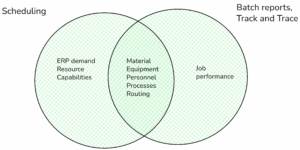
Note how, from this point, you’ve unlocked a whole number of measurements that serve KPIs. Once you have your schedule and performance models in place, you can also calculate how accurately your performance matches the planning.
When use cases have models that overlap, each implementation requires less work.
The hub that conforms to your processes
How much value has been lost trying to force a manufacturing operation to fit into an OEM’s limited vision of how things work? How much technical debt has accrued from all the systems that do function well in the operation but don’t work well with modern protocols and IT?
The Manufacturing Data Hub provides a way to model and connect your current systems, iterate quickly on use cases, and progressively replace old systems while developing new ones.
Only a Manufacturing Data Hub comes with a model designed specifically for the manufacturing operation. Only its unique approach to modeling and workflows can scale to become the brain of any operation, from the single use case to the entire global operation.